Goodbye, Bergoglio
A Decade of Lies and Mud

Two weeks ago, on April 21st, Jorge Mario Bergoglio gave up the ghost.
Easter Monday morning was otherwise uneventful. I woke up. I had my coffee. I checked my phone. One message from a friend, “Francis is dead.”
At first, I interpreted this message as either a cryptic allusion or a hyperbolic jest. I switched tabs to an internet browser and typed in the man’s name to discover what comment or complication the Pontiff conjured to warrant my friend’s jibe. And there it was. “Pope Francis, Dead.”
The bells were not ringing. The streets were not wailing. The only sound was the song of the birds. And so I sat on my sofa, pondering when the city would catch word, if any lamentations would be heard. Half an hour and nothing. So I got up and descended to the streets of my rione, to put a finger on the pulse of the popolo.
In Italy, the day after Easter is known as Pasquetta. It is a holiday, so nobody has to work. On a day when nobody has to do a damn thing, I figured that the death of a Pope would generate a bit of commotion, at least a fleeting interest for a city on break. And yet as I paced the streets and made my rounds, I could not discern a single gesture out of place, or a stray emotion that would indicate something amiss. Without my phone, I would have been none the wiser to the Pontiff’s passing. Finally, I saw a little old man leave the neighborhood church. Like a dispassioned watchman, he began to inform pedestrians of the Pope’s demise. “Il Papa è morto,” he repeated, not particularly somber or grief-stricken, but with the tone of a crone spreading a fresh piece of gossip. I followed the man for a while, inconspicuously probing the faces and reactions of those he passed. The responses ranged from grunts of acknowledgment to muted “ah”s. When he alerted a table of geriatrics roosting outside a bar, they glanced up for a moment, and then returned to their coffee and the morning inertia.
As noon approached, I set out to take a train to St Peter’s, to see if anything was out of place. And upon entering the piazza, I could intuit no such thing. The familiar crowds of foreign flesh were entering and leaving the colonnades, but the volume of men was no different than any other day in April. I heard not a word from the crowds of tourists about the Pope’s passing. And as I stood in the shadow of the obelisk amid the square, I could find no reason to believe that her shepherd had moved on.
At a certain point, I realized that Francis’ fall had fallen on a far older anniversary. April 21st is the birthday of Rome. The day of his death was the city’s 2778th birthday. And I wondered what omen this synchronicity augured, whether it presaged something auspicious or odious. And then the day slipped into night, and the world moved on.
As the funeral approached, things became strange. A visceral juxtaposition began to haunt and taunt me. The media began a blitz that would make an East Bloc propagandist blush. His face appeared everywhere, on the television, on street posters, and maybe even in our dreams. His name was on every tongue, accompanied by unprecedented hagiography and pious laurels. It was as if Christ himself had died, or at least, according to RAI TV.
I decided I would go to see his body, to see the corpse of this man whom I had waged silent war against.
Nature is full of strange laws. One of which dictates that when a man becomes the object of an inimical obsession, his life intertwines with one’s own in inexplicable ways. I had only ever seen Bergoglio from the shadow of the Vatican obelisk, as he delivered his Sunday speeches from his balcony. And yet his presence always seemed to lurk on my periphery. I remember how last year I had been in Castel Gandolfo, the historic summer residence of the Pope, and the area of the legendary Alba Longa where the first Roman king’s ancestors had ruled. Francis had ceased the tradition of the Papal summer residence, converting the Castle into a museum, and thus crippling the local economy. Supposedly, Francis had not been there in years. But something odd occurred on this day. As my friends and I were making our way through the Castel museum, the palace unexpectedly closed, and we were quickly rushed out by guards. As we searched for a taxi to bring us back to Rome, our friend, who is a high-level Vatican guide, noticed his phone’s connection was completely scrambled while the rest of our phones were functioning fine. Later that night, I was informed by this friend that he had received a strange message from a man in the know. That upon telling this man we were just at Castel Gandolfo, he responded, “Funny, my sources tell me Francis was just there too.” You will find no record of this in his official movements, and why he was there in such a covert manner, God only knows. But as any Vatican guide can tell you, when the pope makes an unexpected trip in your area, they occasionally scramble all the numbers registered to the guides. In the original article I wrote on my experience at Castel Gandolfo that day, I had intended to describe this experience in a Part 2. But I decided against it, it sounded too insane. I chose to wait to mention it until after he passed.

I have many other anecdotes of such a nature, and I assure you, I am not implying anything megalomanical. I am merely illustrating a fact. Men’s lives are linked to their foes, even if their nemesis never so much as knows their name. And so I reckon I found it climactic, or at least cathartic, to go see his body lying in state. To sign the final letter in this chapter of my life.
I got up early, on the first day that his body was lying in St Peter’s, to beat the lines and see the dead vicar. Upon approaching the side entrance to the square, I found that the police had completely blocked it off. I thought this was strange, as the square did not seem particularly saturated. The police told us to go to the other entrance down the street. Well, as it would happen, that entrance was closed too. And so the game went, each cop barking that we had to go to another entrance, and I wondered how anyone got in at all. I attempted to go again that night, only to find an identical situation. The next day, I learned from a friend that their sister had gone very late to see the Pope, hoping to avoid the crowds, and ended up waiting five hours in line. And then a certain revelation dawned upon me. I remembered an old economic truth. One can artificially increase demand by restricting supply.
Francis’s body and subsequent funeral appeared to draw a huge crowd. And there were indeed many there. But these were not mournful pilgrims who had lost their spiritual father, but crowds of tourists hoping to ogle a historical curiosity. A man mourning his father does not take a selfie with the corpse at his wake.
During the funeral, the world saw nothing but videos of holy Francis and the millions of devoted followers coming to pay their respects. But they did not see the police officers who consciously mismanaged the entrances to bring the lines to a halt, nor did they see the bored tourists who comprised the “pilgrims” ranks, or the disinterested faces of the Romans on the day of Francis’ death.
I did not see his body. Nor did I attend his funeral. And so Francis went into the ground in the same way that he had walked the earth, lurking in my periphery but never in my sight.
The day after his funeral, I noticed certain Cardinals saying funny things. “The people have spoken through their presence, they desire another Francis to continue his legacy.” The implication, of course, is that the massive crowds recorded around Francis's body and funeral are a sign of his pontificate’s overwhelming popularity, a mandate from the people of God.
A decade of lies and mud.
______________________
For the last year I pondered what I would write for the man’s obituary once he had passed. A long piece full of fire and fury, saturated in historical anecdotes and contemptuous quotations from the lips of greater men.
But when he died, I felt nothing. Not hatred, scorn, pity, nor glee. Only a clear anhedonia, a detachment as diaphonous as crystal, the clarity of waking up from a bad dream. And just as it happens when one awakens from a dream, the vision quickly evaporates with each wakeful moment, before vanishing completely. So too, today, less than a week after the funeral, and the memory of this Pontiff has disappeared from the cityscape. Rome is abuzz with talk of the conclave, but it’s almost as if not a soul can remember the identity of the man whose death set the election in motion.
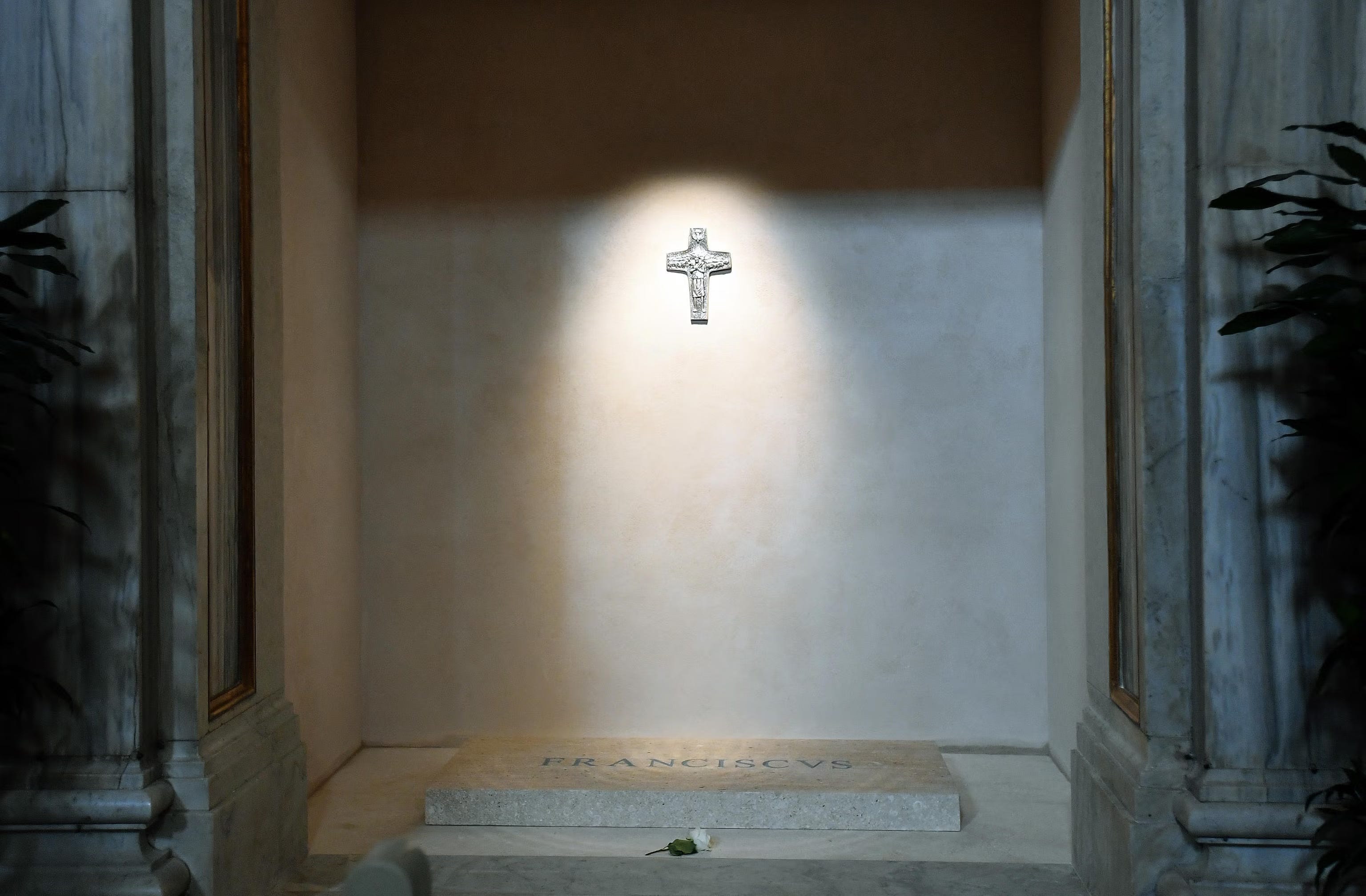
So my obituary will be as long as his epitaph:
Addio, Bergoglio.
__________________
La ʹnvidia a me à dato sì de morso,
che mʹà privato de tutto mio bene,
et àmmi tratto fuori dʹogni mia spene
pur chʹalla vita fosse brieve il corso.
O messer Cino, iʹ veggio chʹè discorso
il tempo omai che pianger ci convene,
poi che la setta che ʹl vizio mantene
par che dal cielo ogni ora abbi soccorso.
Veggio cader diviso questo regno
veggio che a ogni buon convien tacere,
veggio quivi regnar ogni malegno;
e chi vi vuol suo stato mantenere
convien che taccia quel che dentro giace;
nellʹalma, guerra, e, nella bocca, pace